

## Introduction: The Critical Role of Bridge Bearings in Modern Infrastructure
Bridge bearings serve as the vital mechanical interface between the bridge superstructure (deck girders) and the substructure (piers and abutments). They accommodate longitudinal movements caused by thermal expansion, vehicular braking forces, seismic vibrations, and wind loads, while simultaneously transferring vertical gravity loads safely to the foundations.
In bridge engineering across India—specifically for major river crossings, flyovers, and rail-over-bridges (ROBs)—selecting between **POT-PTFE Bearings** and **Elastomeric Rubber Bearings** is a fundamental structural decision dictated by the **Indian Roads Congress (IRC:83)** standards.
---
1. What are POT-PTFE Bridge Bearings?
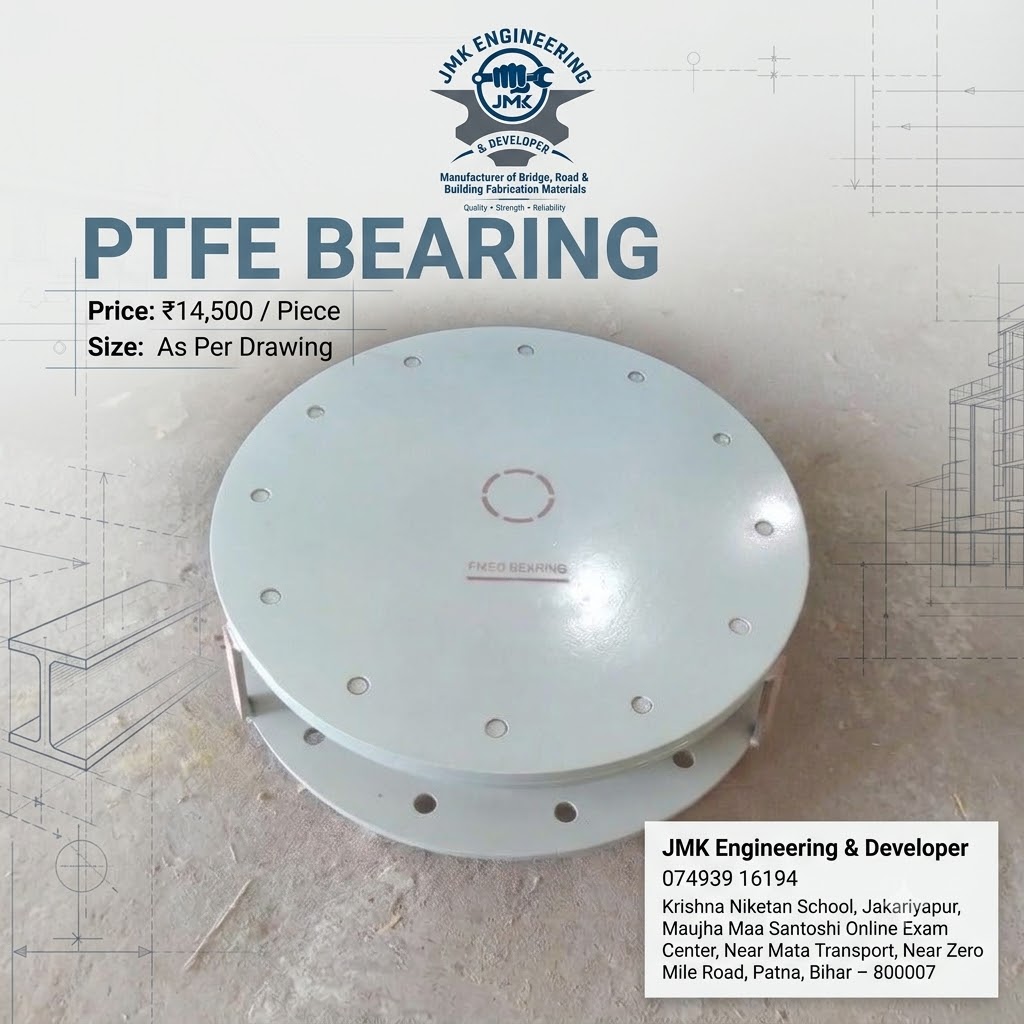
POT-PTFE bearings consist of an elastomeric disc confined within a precision-machined steel cylinder (the "pot"). Under high hydrostatic pressures, the confined elastomer behaves like an incompressible fluid, allowing multi-directional rotation with virtually zero lateral deformation.
A stainless steel sliding plate (mirror polished to Ra ≤ 0.1 µm) slides against a virgin PTFE (Polytetrafluoroethylene) sheet, providing an ultra-low coefficient of friction (typically $\mu \leq 0.03$).
Key Features of POT-PTFE Bearings: - **Ultra-High Load Capacities:** Capable of handling vertical loads exceeding **10,000 kN (1,000+ Tonnes)** per bearing. - **Large Rotational Freedom:** Designed for rotations up to **0.03 radians** in any horizontal axis. - **Types Available:** - *Fixed Bearings (PIN/Fixed POT)* – Allows rotation only, restricts translational displacement. - *Guided Sliding Bearings* – Permits sliding in one longitudinal or transverse direction while resisting lateral forces. - *Free Sliding Bearings* – Multi-directional translation and rotation.
---
2. What are Elastomeric Bridge Bearings?
Elastomeric bearings comprise vulcanized layers of high-grade natural rubber or chloroprene (Neoprene) reinforced with embedded internal steel shims. They accommodate longitudinal and transverse movements through elastic shear deformation of the elastomer, and rotation through non-uniform compression.
Advantages of Elastomeric Bearings: - **Zero Maintenance:** No moving parts, mechanical pistons, or lubrication required over their lifespan. - **Cost-Effective:** Up to 40-50% lower initial procurement cost compared to POT-PTFE systems. - **Vibration Dampening:** Excellent shock absorption properties for railway viaducts and high-speed transit corridors. - **Ideal Span Range:** Best suited for medium span bridges (15m to 35m) with vertical loads up to 4,000 kN.
---
3. POT-PTFE vs Elastomeric: Technical Comparison Matrix
| Parameter | Elastomeric Bearings (IRC:83 Part II) | POT-PTFE Bearings (IRC:83 Part III) |
|---|---|---|
| **Max Vertical Load** | Up to 4,000 kN (400T) | 5,000 kN to 25,000+ kN (2500T+) |
| **Translation Capacity** | Up to $\pm 50\text{ mm}$ (shear deformation) | $\pm 100\text{ mm}$ to $\pm 350\text{ mm}$ (PTFE slide) |
| **Rotational Capacity** | Up to 0.01 radians | Up to 0.035 radians |
| **Design Life** | 20 - 30 Years | 40 - 50 Years (with periodic seal inspection) |
| **Common Applications** | Flyover approaches, RCC Box Girders (15-30m) | Major River Bridges, Cable Stayed Bridges, Steel Trusses |
| **Standard Compliance** | IRC:83 (Part II), MoRTH Section 2000 | IRC:83 (Part III), EN 1337-2, MoRTH Section 2000 |
---
4. Manufacturing Quality Assurance at JMK Engineering Patna
At JMK Engineering & Developers (Patna Central Works), every bearing assembly undergoes rigorous QA testing: 1. **Raw Material Certification:** IS 2062 Grade E250 / E350 steel plates and virgin PTFE conforming to ASTM D4894. 2. **Dimension Verification:** CNC milling and boring ensures tolerance within $\pm 0.1\text{ mm}$. 3. **Proof Load Testing:** 100% test loading up to 1.5x design load on in-house multi-axis hydraulic test rigs. 4. **Surface Coating:** 3-coat polyurethane epoxy paint or hot-dip galvanization for 25+ years corrosion protection.
---
Conclusion & Next Steps
When designing heavy civil infrastructure in Eastern India, choosing the right bearing configuration ensures longevity and structural safety. For technical datasheets, CAD drawings, or ex-factory price estimates, contact JMK Engineering's technical estimation desk at **+91 7493916194**.